
What play-based learning looks like in a real childcare day
When children are deeply involved in play, they are doing serious work. They are testing ideas, taking manageable risks, using language, solving problems and learning how to be with other people.
That sentence is easy to write and easy to nod along to. It is harder to picture. Most parents who ask us about play-based learning are not really asking for a definition. They are asking a more practical question: if my child spends the day playing, what exactly is happening, and how will I know it is working?
This is an attempt at an honest answer. Not the brochure version, but what the approach actually looks like in a room, what the educators are doing while it happens, and what it does not mean.
What play-based learning is not
Two misunderstandings get in the way here, and they pull in opposite directions.
The first is that play-based means unstructured. It does not. A room where children simply do whatever they like with whatever is out is not a play-based program. It is an unplanned one. The structure in a play-based room sits in the preparation rather than in the timetable. Someone decided which materials came out this morning, why those and not others, where they were placed, how much space each area got and which children might be drawn to them. That planning is invisible to a visitor, which is exactly why it is easy to miss.
The second misunderstanding runs the other way: that play-based means academics get postponed until school. Also not true. Counting, letters, patterns, measurement and early scientific reasoning are all in the room. They are embedded in activities children have chosen, rather than delivered as worksheets to children sitting still. A four year old who sets six places at a pretend table, notices she is one plate short and goes to get another has done arithmetic. She has just done it standing up, for a reason she cared about.
The distinction that matters is not play versus learning. It is whether the learning is attached to something the child is actually invested in.
The four foundations behind the approach
Licensed programs in Ontario work from a provincial pedagogical document called How Does Learning Happen? It is built around four foundations: belonging, well-being, engagement and expression. Those four words get printed on a lot of childcare walls, so here is what each one means in practice.
Belonging is whether a child feels like this room is partly theirs. It shows up in small, checkable things. Are there photographs of these particular children and their families on the wall, or generic posters? Does an educator greet the child by name at the door, and does the child have somewhere that is clearly theirs to put their things? A child who does not feel they belong somewhere spends energy on that problem instead of on the sand table.
Well-being covers the physical and emotional basics: sleep, food, movement, being comforted when upset, being helped to manage a body that is still learning to regulate itself. It is unglamorous and it comes first. A hungry or overtired child cannot access anything else on this list.
Engagement is the state of being genuinely absorbed. Not compliant, not entertained. Absorbed. It is the child who does not notice you walked in.
Expression is communication in the broad sense: talking, yes, but also drawing, building, moving, singing, and the enormous amount that infants and toddlers communicate before they have many words.
A useful thing about this framework is that it gives you four questions to carry into any centre you visit, including ours. Does my child belong here. Are they well. Are they absorbed. Can they make themselves understood.
What the educator is doing
This is the part that is hardest to see on a tour, and it is the part that separates a good room from a room with nice toys.
An educator in a play-based room is doing four things more or less continuously.
- Preparing. Choosing what goes out, what gets put away, how the space is divided and what gets added tomorrow based on what happened today.
- Observing. Watching what children are actually trying to do, which is often not what it looks like from across the room. A child knocking over a tower repeatedly may be studying how it falls.
- Deciding when not to intervene. This is genuinely difficult and it is a skill. A child struggling with a puzzle piece is doing the useful part. Solving it for them ends the learning and does them no favours.
- Intervening well when it is time. Usually a question rather than an instruction. What do you think would happen if. Where could that piece go instead. Can you show her how you did that.
There is a fifth thing, less visible again, which is documentation. Educators record what they notice, and that record is what turns a nice morning into a program. It is how anyone knows that a particular child has been circling the same idea for two weeks and is ready for something harder.
Repetition is the point, not a problem
Parents sometimes tell us with a note of worry that their child does the same thing every single day. Same corner, same trucks, same routine.
That is usually good news. Children return to an idea many times, adjusting it slightly each time, until they have wrung it dry. The ramp gets steeper. The tower gets taller before it falls. The same story gets retold with one new character in it. From the outside it reads as repetition. From the inside it is a series of small experiments where the child controls exactly one variable at a time, which is more methodical than most adults manage.
What matters is not variety for its own sake. It is whether the repetition is still developing or has gone flat. A child who has genuinely exhausted an idea usually tells you by drifting away from it. Until then, letting them finish is the respectful thing to do.
Why so much of it is not toys
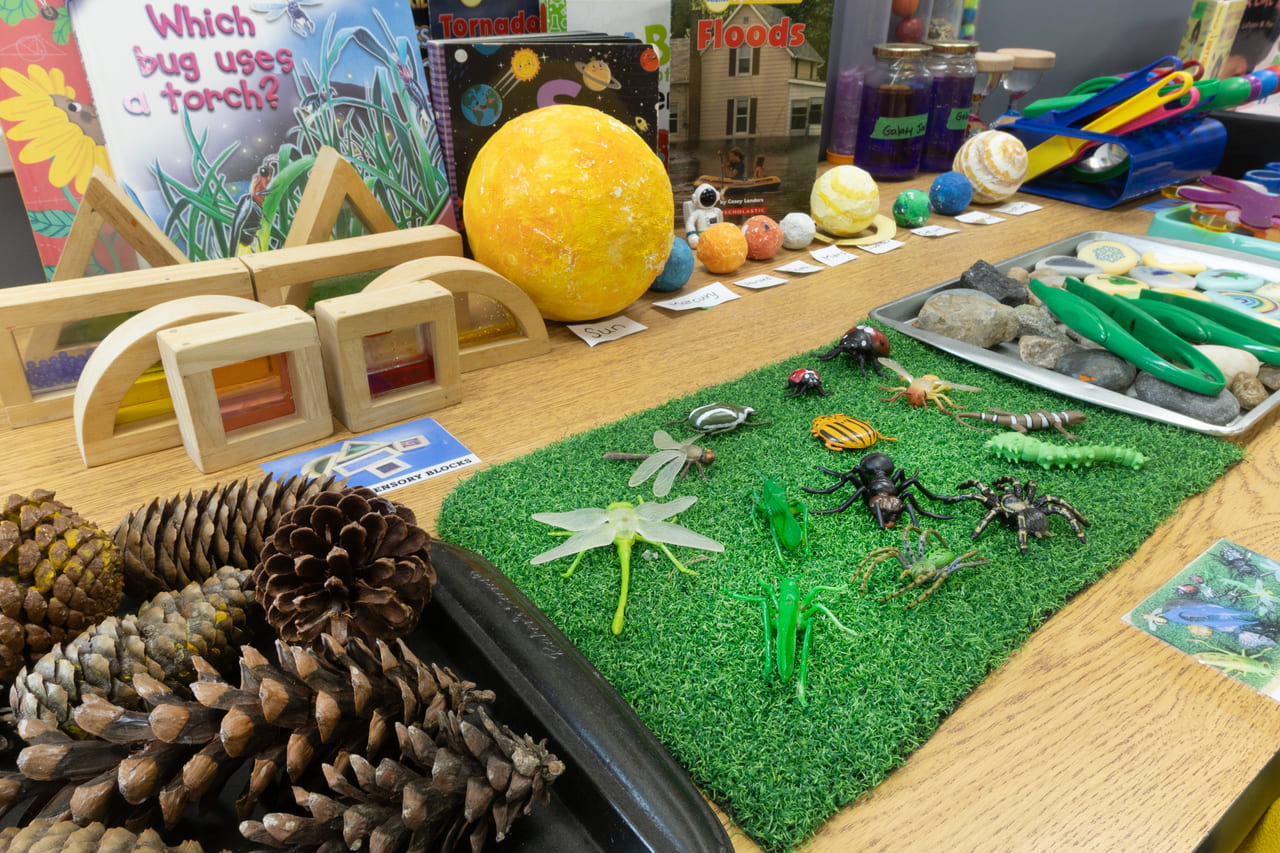
Walk into a well-set-up early learning room and a surprising amount of what you see is not toys in the usual sense. Blocks without a picture on the box. Fabric. Containers. Pine cones, stones, spools, buttons, lengths of tube. Materials that do not do anything on their own.
This is deliberate, and the reasoning is straightforward once it is spelled out. A toy that does one thing teaches a child to operate it. Press the button, the animal makes a noise, and the child learns the button. There is a ceiling on that, and children reach it fast.
A material that does nothing in particular puts the child in charge of deciding what it is. A wooden block is a phone, then a piece of cake, then part of a wall, then a boat. Each of those decisions is an act of imagination and, increasingly as children get older, an act of negotiation with whoever else is playing.
Open-ended materials also solve a practical problem, which is that children in the same room are at wildly different stages. A basket of blocks works for the child who is stacking two and for the child who is building a symmetrical structure and counting the levels. A single-purpose toy usually works for one of those children and bores the other.
This is useful to know as a parent for a slightly awkward reason: the rooms that photograph best are not always the rooms that work best. Bright plastic sets look organised and appealing in pictures. Baskets of odds and ends look like clutter. On a tour, the question to ask is not how much equipment is there, but how much of it can be used in more than one way.
When play goes wrong
Any honest description of a play-based room has to account for the parts that are not charming. Children take things from each other. They exclude each other. They hit, bite, shout and fall apart over a colour of cup. This is not a sign that something has broken down. It is the predictable result of putting a group of people together who want things and do not yet have the tools to sort that out.
These moments are also where a large share of the actual social learning happens, which is why an educator's response to them tells you more about a program than any display board.
A response to look for tends to have a few features. It names the feeling rather than only the rule, because a child who is flooded cannot hear a rule. It gives the child the language they were missing, out loud, in words they could use next time. It involves the other child rather than treating the incident as a private matter between adult and offender. And it does not require a performed apology, which teaches children to say a word rather than to notice they hurt someone.
Exclusion needs saying separately because it upsets parents more than almost anything else and it is very common from about three onwards. You cannot play with us is one of the first pieces of social power children discover, and they test it thoroughly. The useful adult response is not to force inclusion in every case, which teaches nothing and satisfies nobody. It is to be present for the conversation, to make the excluded child's position visible to the others, and to help both sides find a version of the game that has room in it.
If you are told on a tour that conflict is rare in a room of preschoolers, that deserves a follow-up question. Either the room is unusually managed in a way that suppresses it, or the answer is not quite complete.
Will my child be ready for school?
This is the question underneath most of the other questions, so it deserves a direct answer rather than a reassuring one.
Kindergarten in Ontario is itself play-based, so there is less of a gap than parents fear. But school readiness is broader than letters and numbers, and the parts that a play-based room builds well are the parts that are hardest to teach directly.
Can the child separate from a parent and recover. Can they ask an adult who is not their parent for help. Can they wait, share, lose, and stay in the room afterwards. Can they manage a coat, a lunch bag and a washroom trip without an adult doing it for them. Can they persist at something that is not immediately working. Can they sit with a group and attend to someone else talking.
Those capacities are what make the academic content stick later. A child who can persist and ask for help will learn to read. A child who has memorised letters but falls apart at the first difficulty will have a harder time than their head start suggests.
None of which is an argument against the academic content. It is in the room, all day, attached to things children have chosen.
How it changes across the age groups
The principle holds across every room. The way it looks changes completely.
Infants, newborn to 18 months
Play at this age is sensory and relational, and it is inseparable from care. Being fed, changed and put down for a nap by the same responsive adults is the learning. Reaching for something just out of range, mouthing it, dropping it and watching an adult return it: that loop teaches cause, effect and trust at the same time. The environment matters less than the consistency of the people in it.
Toddlers, 18 months to 2.5 years
Movement, repetition and testing limits. Toddlers are running a large research project on what happens when. Language arrives fast in this window, which means naming things out loud constantly is one of the most useful things an adult can do. Conflict is frequent and developmentally normal, because two toddlers who both want the same object do not yet have a way to solve that.
Preschool, 2.5 to 4 years
This is where sustained pretend play takes off, and with it the biggest gains in language and social reasoning. Play gets planned in advance, roles get assigned and disputed, and stories run across several days. Early literacy and number work fold in naturally because children now want signs, labels, lists and scores for the games they are inventing.
School age, 4 to 12 years
Before and after school and through the summer, play looks different again: rules, fairness, projects, clubs, friendship, and a strong preference for doing things without an adult hovering. Children this age have been directed all day at school. What they need in the afternoon is choice, physical activity, food, and adults who are available without being intrusive.
What you can see from outside the room
Families here get photos, daily reports and direct messages from their child's room through Lillio, which helps, though it helps to be clear about what any parent app can and cannot show you. It gives you moments and routines. It does not give you the reasoning behind them.
For that, the pickup conversation is better, and one small change makes it much better. Most of us ask what did you do today, which invites the accurate but useless answer: played. Try asking what were you working on. Or who did you play with, and what did you build, and what went wrong.
You can also just ask the educator directly. Not how was he today, which will always get a friendly non-answer, but something specific. What has he been interested in this week. Is there anything he has been avoiding. What are you planning to put out for him next.
If you want to see this in person, the most honest thing you can do is visit during a busy part of the morning rather than at nap time. Call us on (905) 683-2559 or email info@tenderyearschildcare.ca and ask to come when the rooms are actually running.
A last thought
Play-based learning asks adults to trust a process that does not look much like teaching. That is a real ask, especially for parents who are paying for childcare and want to see progress they can name.
The progress is there. It is just filed under headings that do not appear on a report card at this age: persistence, negotiation, curiosity, recovering from frustration, the ability to be interested in something for a long time. Those are the things that make the rest possible, and a child who spends a few years building them well is not behind. They are further ahead than they look.