

Choosing child care: questions worth asking on a tour
A childcare tour is your chance to notice how a program feels as well as how it looks. Many tours run twenty minutes or so, much of it a walk down a corridor, and it is very easy to come away with a warm impression and no actual information.
That is not anyone's fault. Centres are busy, you are being polite, and it is genuinely awkward to interrogate someone about their workplace while they are showing you around it. But you are making a decision about who spends more waking hours with your child than you do, on the strength of one short visit.
What follows is the set of questions worth having ready, organised by what they actually tell you. Some of them are uncomfortable to ask. A good program will not mind any of them.
Before you book
Two things to do before you turn up.
First, check the licence. In Ontario, child care centres are licensed by the Ministry of Education under the Child Care and Early Years Act, 2014. A licensed centre has to post its licence, and licensing and inspection information for licensed programs is published by the province. Looking at that in advance is free, takes a few minutes, and means you can spend the visit on things you cannot learn from a website.
Second, ask to visit at a time when the rooms are running. Late morning is usually more revealing than nap time. If you can only be offered a slot when children are asleep or the room is empty, make a note of it, though it is often just scheduling rather than anything more.
It also helps to know what you actually need before you go, because it changes which answers matter. The hours you need covered. The days. When you need to start. Whether you have flexibility on any of it. A program that is excellent but cannot cover your Thursday is not a program you can use.
The first two minutes: look, do not ask
Before any question, spend the opening of the visit watching. You will not get this chance again once the conversation starts.
Watch how educators speak with children. Not whether they are friendly to you, which everyone is on a tour, but the register they use with a two year old who is upset. Do they crouch down. Do they use the child's name. Is the tone the same as the one they are using with you, or does it change into something performed.
Watch what happens when a child interrupts the tour, because one will. Does the educator treat it as an intrusion to be managed, or as a child who needs something. That reaction is hard to fake and it tells you a lot.
Watch the children who are not doing anything. Every room has a child at the edges. Notice whether an adult goes to them.
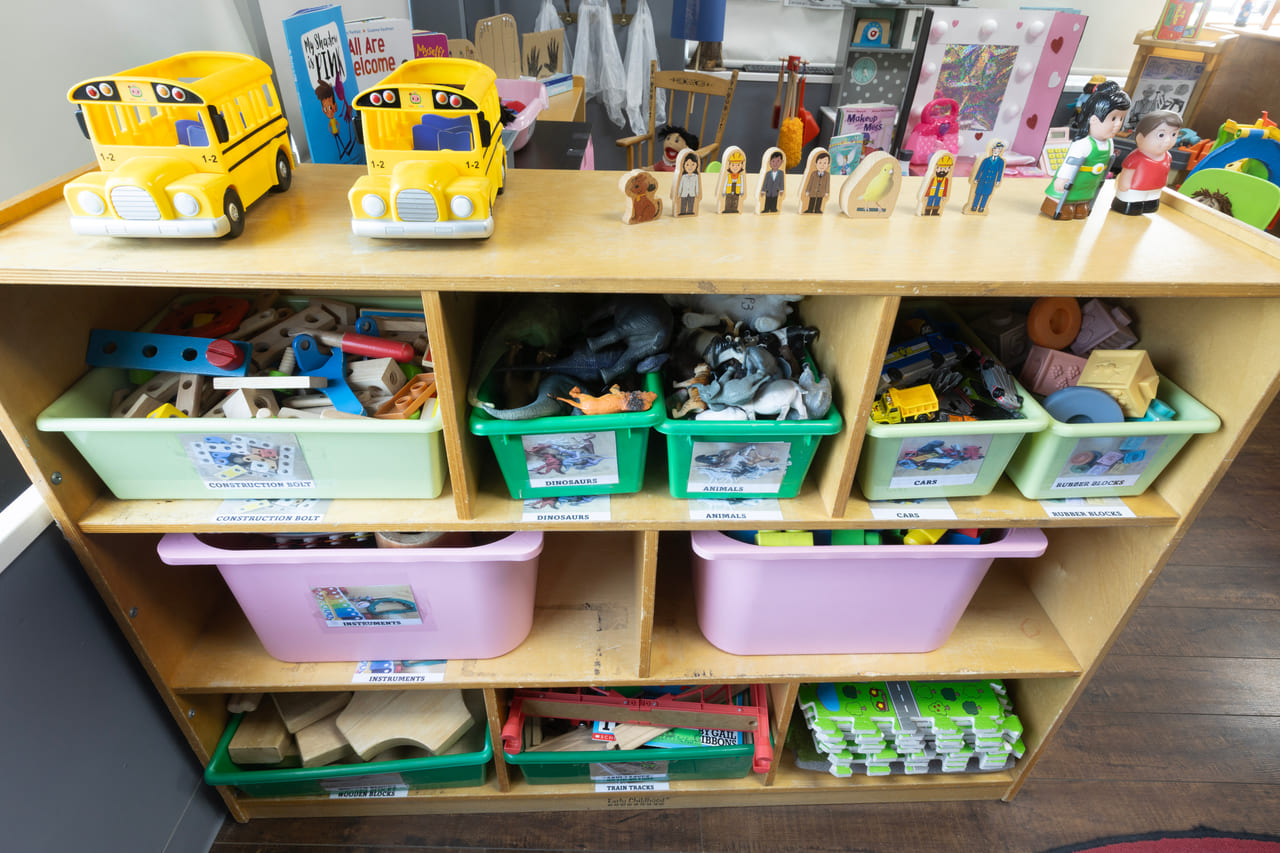
Then look at the materials and how they are arranged. Are things at child height and reachable without asking. Is there evidence that the setup was thought about this week, or does it look like it has been the same since spring. Is children's own work on the walls, or only commercially printed posters and identical crafts where every snowman is the same.
Questions about the room your child would be in
This is the single most common mistake on a tour: people assess the centre when they should be assessing one room. Your child will spend their days in a specific room with specific adults, and rooms within the same centre differ.
- Which room would my child be in, and can I see that room with children in it?
- How many children are in that group, and what is the ratio of educators to children?
- How is that ratio maintained at opening, at closing, during staff breaks and when someone is away?
- Who would my child's main educators be, and how long have they been in that room?
- What happens when my child moves up to the next age group? How is that transition handled and how much notice do families get?
The ratio question deserves a note. Ontario regulation sets minimum ratios and maximum group sizes for each age group, so any licensed centre will meet them. The more useful question is the second one, about how the ratio holds up at the edges of the day. That is where practice varies.
The transition question matters more than people expect. Moving rooms is one of the harder things that happens to a young child in care, and programs handle it very differently. Some visit gradually over weeks. Some move a child on their birthday. Ask which.
Questions about the people
Staff turnover is the thing that most affects a child's experience and the thing least likely to come up on a tour.
- How many of the educators in that room are registered early childhood educators?
- How long have the educators in that room been at the centre?
- How much turnover has there been in the last year?
- Who covers when an educator is away, and do children know that person?
- What ongoing training do educators get, and who decides what it covers?
Registered early childhood educators in Ontario are members of the College of Early Childhood Educators, which sets the standards for the profession. Asking how many people in the room hold that registration is a normal question and centres are used to it.
On turnover, listen for how the answer is given as much as its content. Some turnover is normal and unavoidable in this sector. An answer that acknowledges it plainly and explains how the room was kept stable is more reassuring than one that implies there has been none.
Sleep, food and physical care
For younger children this is most of the day, and it is where a mismatch between home and centre causes the most friction.
- How do educators learn each child's routines, comfort cues and interests when they start?
- For infants, is feeding and sleeping on the child's schedule or the room's?
- Where do children sleep, and what happens for a child who does not sleep?
- Are meals prepared on site or brought in, and can I see a current menu?
- How are allergies, dietary requirements and medical care plans handled, and who is responsible for them day to day?
- What is the policy on a child who refuses to eat, and does that get reported to me?
Tender Years cooks meals on site, with a morning snack, hot lunch and afternoon snack, and the current menu is available on request. Whatever the centre, asking to see an actual menu rather than a description is a reasonable request and the answer tells you something either way.
The question about a child who does not sleep is more diagnostic than it sounds. Every room has children who have dropped their nap before the room's schedule expects it. What is offered to those children, and whether the answer is a real plan or a shrug, says a lot about how individual the care is.
Outdoor time and movement
- How much time do children spend outdoors, and in what weather?
- What does the outdoor space actually offer, and can I see it?
- What happens on days when going outside is not possible?
- How is gross motor play supported indoors?
Ask to see the yard rather than accepting a description, and look at what is in it. Space to run, things to climb, something to push or ride, some shade. Tender Years has two oversized playgrounds, which is easier to judge in person, because outdoor space varies more between centres than almost anything else and photographs flatter it.
Conflict, big feelings and behaviour
This is the question most parents skip and the one that separates programs most clearly.
Ask how the team responds to conflict between children, to a child who is overwhelmed, and to behaviour that is unsafe. Then listen for whether the answer is grounded in calm guidance, clear boundaries and expectations that match the age of the child.
Some follow-ups worth having ready:
- What does the room do when a child hits or bites another child? What happens for each of them?
- Are children ever separated from the group, and if so, what does that look like?
- At what point would you contact me, and at what point would you ask us to work on something together?
- Has a child ever been asked to leave the program, and what led to that?
An answer that treats a three year old's outburst as a developmental event to be supported is a different program from one that treats it as misbehaviour to be corrected. Both may sound reasonable in a sentence. The difference shows up in the detail, so ask for a specific example rather than a policy.
Communication with families
Communication matters on ordinary days and it matters enormously on difficult ones.
- What will I hear at pickup on a normal day?
- How do I raise a longer concern, and who is my main contact?
- How quickly would I hear about an injury, an incident or a change in my child's day?
- How does the centre communicate closures, illness in the room and staffing changes?
- Is there an app, and what does it actually show me?
Tender Years uses Lillio, so families get photos, daily reports and direct messages from their child's room. Be realistic about what any parent app does. It gives you moments and routines reliably. It does not replace a conversation, and a program that leans on the app instead of talking to you at the door has substituted one for the other.
The question about raising a concern is the important one in this group. Ask it directly: if I am unhappy about something, who do I go to, and what happens next. A clear answer with a named role is a good sign.
Fees, CWELCC and the practical details
Bring the money questions and ask them plainly. Nobody minds.
- What is the fee for my child's age group and schedule, and what does it include?
- Does CWELCC apply to my child, and what would I actually pay?
- What is charged on statutory holidays, closures, vacation and sick days?
- Is there a deposit or registration fee, and is it refundable?
- What notice is required if we leave?
- What do I need to supply, and what does the centre provide?
On CWELCC: Tender Years participates in the Canada-Wide Early Learning and Child Care system, and eligibility depends on the child's age and program, so it does not automatically apply to every place. Ask the centre for the current fee that would apply to your child specifically rather than working from a general figure. If cost is a constraint, Durham Region also administers fee subsidy, and that is a separate question to ask.
Hours are part of the practical picture too. Tender Years is open 6:30 a.m. to 6:30 p.m., Monday to Friday. Whatever the centre, check the late pickup policy and what it costs, because it is the detail most likely to matter on a bad day.
Availability and the waitlist
- Do you have a place for my child's age group, and when?
- How does the waitlist work, and where would we sit on it?
- Does anything move a family up, such as a sibling already enrolled?
- How and when would you contact me, and how long would I have to decide?
At Tender Years, requests are generally considered first-come, first-served and remain subject to availability, with priority for siblings of enrolled children and for children moving into the next age group. An enquiry does not guarantee a place. That is roughly the shape of it at most centres, but the details differ, so ask rather than assume.
Things that are not on any checklist
A few smaller signals that tend to correlate with how a place is run.
- The noise. A room of young children should not be silent. It also should not be chaotic. What you want is a busy hum with adult voices in it at normal volume.
- Whether adults are sitting down. Educators who are down at child height and involved are doing something different from educators standing at the edges supervising.
- The walls. Children's own work, in their own handwriting, at their own eye level, tells you the room belongs to them.
- Whether staff greet each other. How adults treat each other in front of you is a reasonable proxy for what the workplace is like, and workplaces with low turnover are better for children.
- Whether you are rushed. A centre that will not let you stand and watch for a few minutes is telling you something.
After the tour
Write your impressions down the same day. If you are seeing several centres, they blur faster than you expect, and it is the specific detail you will lose first.
Then send a follow-up question by email. This is the most underrated thing on this list. It tells you how the centre communicates when you are not standing in front of them, which is how you will be dealing with them for the next several years. A prompt, specific, human reply is a genuinely good sign. A reply that takes a week is data too.
And be honest with yourself about the feel of the place, while remembering that your reaction to a building is not the same as your reaction to the care. Some excellent programs run in plain rooms. Some beautifully finished centres are ordinary once you look at what the adults are doing.
To arrange a visit to Tender Years, call (905) 683-2559 or email info@tenderyearschildcare.ca. We are at 338 Rossland Rd E in Ajax, and it is best to ask for a time when the rooms are busy rather than quiet.